

Halo-Halo in Halifax: The Filipino Shaved Ice Dessert at Barrios
Try Halo-Halo at Barrios Halifax. Layers of shaved ice, sweet fruits, ube halaya, and house-made leche flan — the unofficial national dessert of the Philippines, now on Barrington Street.
Barrios Restaurant & Bar
6/1/20266 min read
Halo-Halo in Halifax: The Filipino Shaved Ice Dessert at Barrios
Filipino Dessert Guide · Barrios Halifax · 1571 Barrington St, Downtown Halifax
If you've been looking for desserts in Halifax that are unlike anything else in the city — something cold, layered, colourful, and built on a tradition that goes back generations — Halo-Halo at Barrios is exactly that. It's the unofficial national dessert of the Philippines: a tall glass of shaved ice layered with sweet fruits, jellies, beans, and toppings, finished with evaporated milk and served with a long spoon so you can dig through every layer. At Barrios Halifax on Barrington Street, it's one of the most visually striking things you can order — and one of the most fun to eat.
This guide covers what Halo-Halo is, where it comes from, what goes into it, and why it's the dessert to order when you're done with your meal at Barrios in downtown Halifax.
What is Halo-Halo?
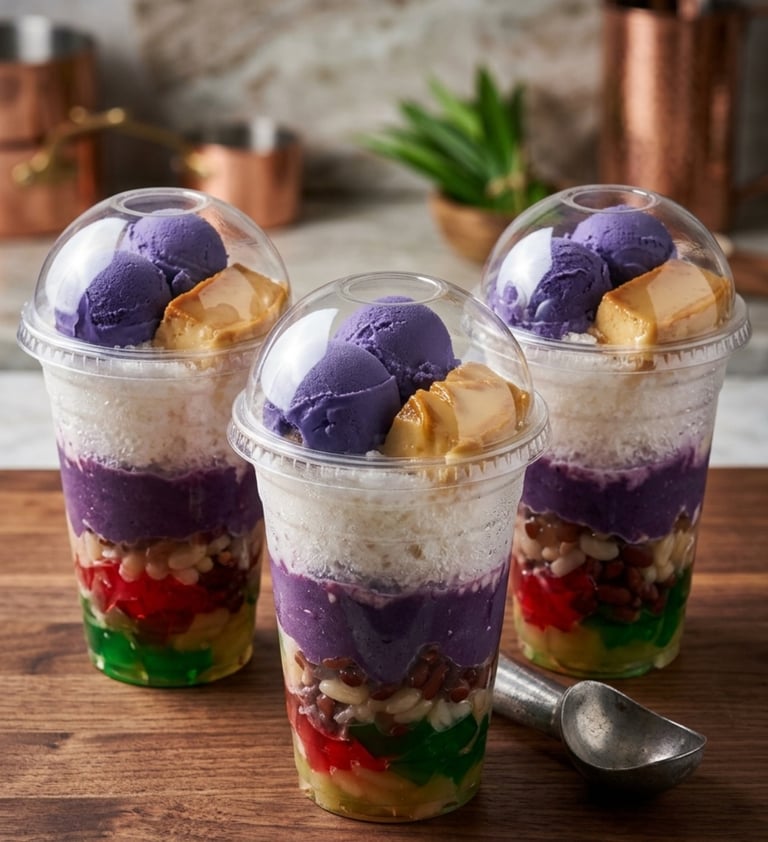
The name says it all. "Halo-halo" literally translates to "mix-mix" in Filipino — a direct instruction for how the dessert is meant to be eaten. It's a layered dessert built in a tall clear glass, starting with sweet fruits, beans, and jellies at the bottom, followed by a generous mound of finely shaved ice, then topped with evaporated milk, ube halaya (purple yam jam), leche flan, and often a scoop of ice cream. You mix everything together before eating, which is when the dessert transforms — the ice breaks down, the milk runs through the layers, and every spoonful becomes a different combination of textures and flavours.
Halo-Halo is considered the unofficial national dessert of the Philippines. It's eaten at roadside stalls, fast food chains, fine dining restaurants, and Filipino homes across the country, and it means something different to every Filipino who grew up eating it. No two Halo-Halos are exactly alike — the ingredients vary by region, by restaurant, and by personal preference — which is part of what makes it so endlessly interesting.
The History Behind the Dessert
Halo-Halo has a history that reflects the Philippines' multicultural identity. Its origins trace back to Japanese immigrants in the Philippines during the 1920s and 1930s, who introduced kakigori — Japanese shaved ice sweetened with condensed milk and syrup. Their early version, known locally as "mongo-ya," featured mung beans cooked in syrup served over crushed ice with milk and sugar. It was simple, cooling, and perfectly suited to the tropical Philippine climate.
As Japanese influence evolved and local Filipino ingredients became central to the dessert, mongo-ya transformed into what Filipinos now call Halo-Halo — a dramatically expanded version that incorporated jackfruit, coconut strips, sugar palm fruit, sweet potato, tapioca pearls, agar jellies, and eventually leche flan and ube. The establishment of the first commercial ice plant in the Philippines in 1902 made shaved ice widely accessible, and from there the dessert spread across every region of the country, picking up local variations and ingredients along the way.
By the mid-20th century, restaurants and roadside stalls across the Philippines had made Halo-Halo a signature offering. It became a cultural touchstone — the dessert you eat on a hot summer afternoon, the one you remember from childhood, the one Anthony Bourdain called "oddly beautiful" when he tried it at a Filipino restaurant in Los Angeles.
What Goes Into Halo-Halo
There is no single definitive Halo-Halo recipe — the beauty of the dessert is that it's built on layers and customised by whoever is making it. That said, the classic version includes a specific set of components that define the experience:
The base layer sits at the bottom of the glass and typically includes sweetened beans, nata de coco (coconut gel), kaong (sugar palm fruit), gulaman (agar jelly), and saba bananas cooked in syrup. These provide the sweet, chewy foundation that anchors everything above.
The shaved ice goes in next — finely shaved, not crushed, so it has a soft, snow-like texture that melts slowly and absorbs the flavours around it rather than turning into hard, icy chunks.
The milk is poured over the ice — traditionally evaporated milk, which is richer and slightly more caramelised in flavour than fresh milk. It runs down through the ice and into the base layer, binding everything together.
The toppings are where Halo-Halo becomes visually impressive and personally distinctive. Ube halaya (purple yam jam) adds a vivid violet colour and a sweet, earthy flavour. Leche flan adds richness and the same caramel depth you find in Barrios' house-made custard. A scoop of ube ice cream on top is the crowning element — cold, creamy, and spectacularly purple.
Why Barrios' Halo-Halo is Worth Ordering in Halifax
Finding authentic Halo-Halo near you in Halifax is genuinely rare. It's not a dessert that translates easily onto a non-Filipino menu — the specific ingredients, the layering technique, and the shaved ice texture require a kitchen that knows what it's doing. Barrios is one of the only places in Atlantic Canada serving it, which alone makes it worth ordering.
What makes the Barrios version stand out is the connection between the Halo-Halo and the house-made Leche Flan. The Leche Flan served at Barrios — steamed from scratch using a family recipe — is the same custard that tops the Halo-Halo. That's the difference between a Halo-Halo built from quality components and one assembled from convenience ingredients. When you eat a spoonful that combines shaved ice, evaporated milk, ube, and a piece of Barrios' house-made leche flan, you're getting the real thing.
How to Eat Halo-Halo Like a Local
Use a long spoon and mix everything together before your first bite — don't eat it in layers
Work quickly — the ice melts fast and the dessert is best when everything is still cold
Make sure every spoonful has shaved ice, milk, and at least one topping for the full combination
The ube and leche flan are best eaten early while they're still cold and firm
Share it if you want, but most people end up wanting their own once they start
Halo-Halo vs Other Desserts in Halifax
If you're deciding between Halo-Halo and Leche Flan at Barrios, here's the honest comparison:
Halo-Halo is the experience dessert — cold, refreshing, interactive, and visually dramatic. It's ideal if you want something lighter after a heavy meal, or if you've never had it before and want to understand what Filipino dessert culture is about. It's best on a warm evening or shared at the table.
Leche Flan is the rich dessert — dense, silky, caramel-topped, and deeply satisfying in small portions. It's ideal if you want something indulgent and precise rather than refreshing and layered.
Order both if you're at a table of two or more. They're completely different eating experiences and together they represent the full range of Filipino dessert tradition.
A Dessert That Tells the Story of Filipino Culture
Halo-Halo is more than just a cold sweet. It's a reflection of the Philippines' history — Japanese shaved ice techniques, Spanish colonial sweets, local tropical fruits, and generations of Filipino cooks adding their own ingredients and interpretations. Every glass is different. Every bite surprises. And in a city like Halifax where Filipino desserts are almost impossible to find, the fact that Barrios serves a proper Halo-Halo on Barrington Street is genuinely worth knowing about.
Barrios is located at 1571 Barrington Street in downtown Halifax, steps from the Halifax Waterfront and close to Neptune Theatre and Scotiabank Centre. Open seven days a week for lunch and dinner, with walk-ins welcome and reservations recommended for groups on weekends.
Frequently Asked Questions
Where can I find Halo-Halo near me in Halifax?
Barrios Halifax at 1571 Barrington St in downtown Halifax serves authentic Filipino Halo-Halo for lunch and dinner every day — one of the only places in Atlantic Canada where you can find this dessert made properly.
What is Halo-Halo made of?
Shaved ice layered with sweetened fruits, beans, jellies, and coconut, topped with evaporated milk, ube halaya (purple yam jam), leche flan, and ube ice cream. Mixed together before eating.
What does Halo-Halo taste like?
Cold, creamy, sweet, and texturally varied — every spoonful is different depending on what layer you're in. The ube adds earthy sweetness, the leche flan adds caramel richness, and the shaved ice keeps everything refreshing.
Why is it called Halo-Halo?
Halo-halo means "mix-mix" in Filipino — it's both the name of the dessert and the instruction for how to eat it. You mix all the layers together before eating so every spoonful has a different combination of ingredients.
Is Halo-Halo very sweet?
It's sweet but balanced. The shaved ice and evaporated milk temper the sweetness of the toppings, and the slight bitterness of the leche flan caramel keeps it from feeling cloying. It's more refreshing than heavy.
What is ube?
Ube is purple yam — one of the most beloved ingredients in Filipino dessert cooking. It has a naturally sweet, slightly nutty flavour and a vivid violet colour. In Halo-Halo it appears as ube halaya (purple yam jam) and often as ube ice cream on top.
Come Try Halo-Halo at Barrios Halifax
Halo-Halo is the dessert that makes people stop mid-bite and reconsider everything they thought they knew about cold sweets. At Barrios Halifax, it's on the menu every day at 1571 Barrington Street in the heart of downtown Halifax. Come in for lunch or dinner and save room for it — or order Leche Flan alongside it for the full Filipino dessert experience.